

How Google Core Update Broke the Rules of SEO Tracking

A strange thing began to occur in mid-May 2026. When SEO specialists looked up the same keyword at the same time, they were seeing entirely different results – not just slightly different, but dramatically different. A website that appeared in the top three for one person was completely invisible to another. The tracking tools were providing positions that did not match those obtained from manual searches. Since the field relies on measurable and repeatable data, this was a problem for which no one had a clear solution.
What emerged from the chaos had a name, even if Google never officially gave it one: the Dynamic SERP Update.
What Actually Happened
The May 2026 Core Update carried out the usual activities of a core update – it reorganized the rankings, gave advantages to some websites, and penalized others. However, something contained within the overall update went largely unnoticed until SEO professionals began comparing their observations.
It was first publicly pointed out by Schieler De’Land, an SEO professional who monitors keyword performance for a number of clients: when users entered the same search queries, they were directed to entirely different result pages. This was not due to caching. It wasn’t caused by differences in device or a timezone anomaly. Rather, something had changed in how Google was serving up the results.
Yext moved quickly when it came to the analysis. When it took data from users who were not logged in – thus deliberately eliminating personalization as a variable – it found a clear inflection point during the week of May 18, 2026. Organic ranking volatility increased by 48.7% compared to the previous baseline. In 97 percent of the reports they reviewed, volatility had increased. That isn’t just statistical noise. That’s evidence of a change in the way the SERP functions.
Mobile Organic Rankings Took the Hardest Hit
The various result types did not change by the same amount. The mobile organic results for keywords that include geographic modifiers – for example, ‘plumber near me’ or ‘best dentist in Austin’ – exhibited the most dramatic fluctuations. The local pack results were affected as well, but the changes there were more moderate.
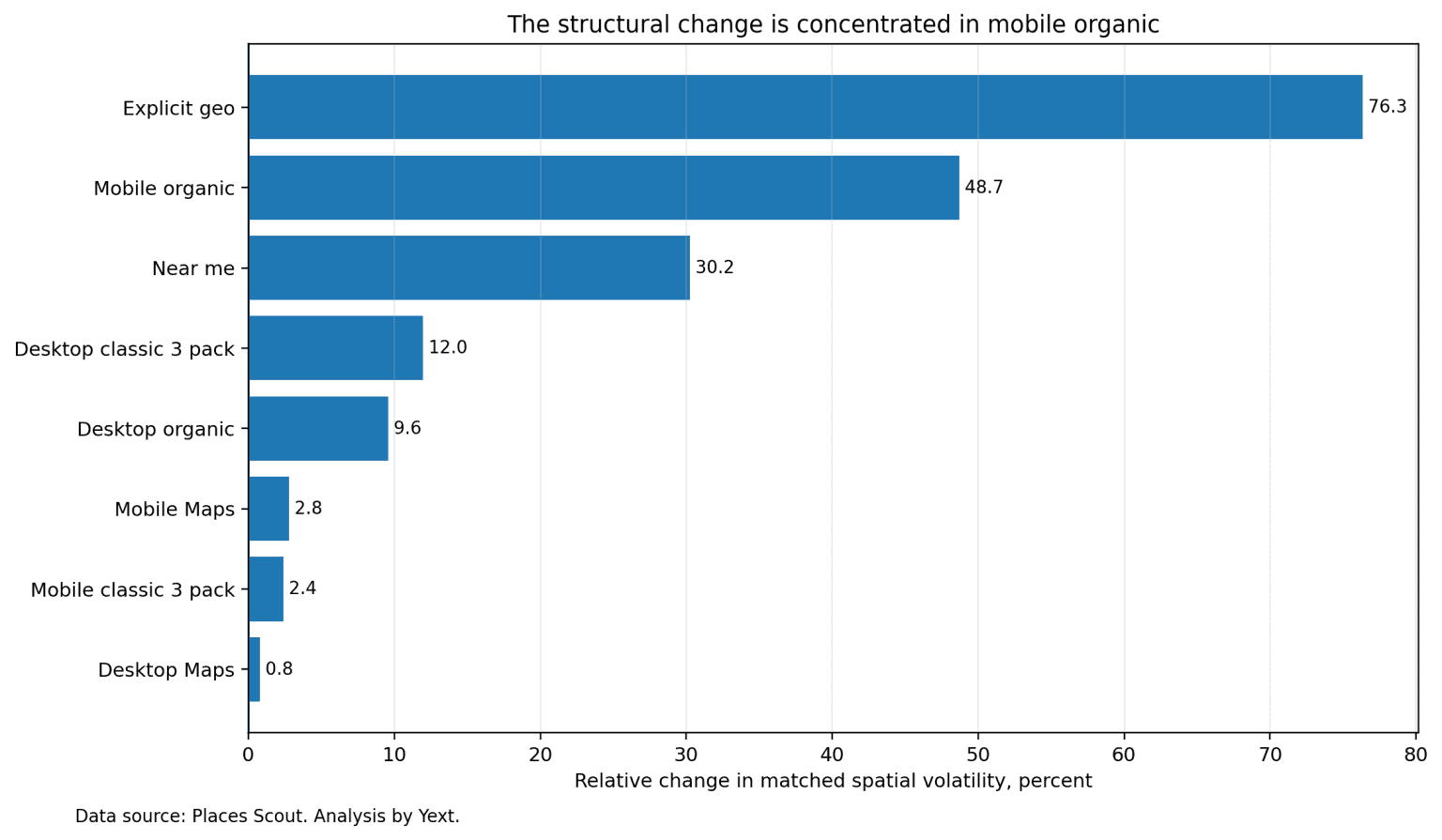
Mobile organic volatility is so important since most local search traffic is found there; if a person in Chicago searches on their phone at 11 p.m. for “emergency HVAC repair” and three different people carrying out that identical search receive three genuinely different result sets, then the idea of being ranked number two for that keyword becomes almost meaningless as a performance metric.
Members of the Local Search Forum observed that the keywords they had been monitoring over the years with stable and predictable patterns suddenly became erratic, the positions which had remained unchanged for months now swinging by ten, fifteen, or twenty places depending on who was checking and when.
Why This Isn’t Just Personalization
The first thought when noticing different results at the user level is to blame Google’s personalization systems. For more than ten years now, Google has been altering its results according to search history, location information, and behavioral data. It is not new for users to see different results.
That explanation doesn’t apply in this case, and the purpose of the Yext analysis was to examine it. They were able to identify the variability as arising at the algorithm level, not at the user profile level, by looking at data from users who were logged out – that is, from accounts to which no active personalization profile was being applied.
Personalization leads to variations that are related to individual behavior. What the Dynamic SERP Update actually resulted in was a kind of random distribution – similar users having similar profiles yet receiving different results for the same query at the same time. The difference in ranking between users was not linked to their browsing history or to their location; it was systemic.
This difference is of great importance when it comes to SEO strategy; if the variation is driven by the need for personalization, then you should optimize for the user groups that you wish to reach, but if the variation is driven by the algorithm and is therefore unpredictable, you will need a completely different approach when it comes to assessing whether your SEO is working or not.
The Measurement Problem This Creates
Here’s where things get genuinely difficult for SEOs and the businesses they serve. Traditional rank tracking works on an assumption: if you check where a URL ranks for a given keyword, that position reflects a real, durable state of Google’s evaluation. Check it today, check it tomorrow, and you’re measuring movement in the underlying ranking.
That assumption is now broken.
A rank check for a particular keyword, including geographic modifiers, could yield a position that reflects only how Google displayed results to that data center at that exact moment in response to that specific query variation. If you carry out the same check from a different IP address or at a different time, the figure will be different. Although your rank-tracking dashboard may display a smooth line chart, the actual user experience is more like a scatter plot.
This results in a genuine accountability gap; although an SEO agency might be correct when it says ‘we have kept your position at number 2 for [keyword]’ according to the snapshot from their tool, the actual customers of the client are experiencing very inconsistent results, and both the agency and the client can be acting in good faith even though they are working with incomplete information.
This creates a real accountability gap. An SEO agency reporting “we maintained your position 2 ranking for [keyword]” might be technically accurate based on their tool’s snapshot, while their client’s actual customers are getting wildly inconsistent results. Both parties can be acting in good faith while operating on incomplete information.
The practical implication: daily rank scans, already a limited representation of real-world performance, became even less reliable after May 2026. The agencies and professionals still anchoring their reporting to those numbers are measuring something increasingly divorced from business reality.
What Reliable SEO Measurement Looks Like Now
When rank tracking is compromised, the performance signals that are not compromised become more important.
Call tracking is direct. If your SEO work is driving inbound calls, that result survives the SERP volatility problem. A phone that’s ringing is ringing regardless of what position a rank tracker reports. Tying specific pages to inbound call volume gives you a ground-truth measurement that algorithm changes can’t distort.
UTM parameters applied to Google Business Profile links give you visibility into which keywords are actually driving traffic – not estimated traffic based on reported position, but real click-through data tied to real visits. For local businesses especially, this level of tracking closes the gap between what ranking reports suggest and what’s actually generating leads.
Longer trend windows matter more than ever. A single week of rank data is nearly useless for assessment. Three months of aggregated performance data, smoothed across the volatility, gives a more accurate picture of whether a site is gaining or losing ground in a meaningful way.
Revenue attribution is the final arbitration. Which pages are driving business outcomes? Which keyword-driven sessions are converting? The SERP volatility doesn’t affect the conversion funnel downstream – it only affects how consistently users reach the top of that funnel. Build your reporting backward from revenue and let that anchor your evaluation of what’s working.
Industry Variation and What It Means for Strategy
The Dynamic SERP Update didn’t hit every market equally. Industries with highly localized, high-intent, mobile-dominant search behavior felt it most acutely – home services, healthcare, legal, restaurants. Categories where users consistently append location modifiers or where Google is inferring location from device signals were ground zero for the volatility spike.
Nationally-focused, desktop-weighted categories saw less disruption, though the underlying changes to how Google serves dynamic results apply across the board. The difference is magnitude, not immunity.
For SEOs working in local and regional markets, the strategic implication is clear: brand recognition and multi-channel visibility become stronger competitive assets when ranking positions are volatile. A business that owns the top organic position might be invisible to 30% of its potential customers on any given day. A business with strong brand awareness, consistent reviews, high GBP engagement, and a website that converts well when visited – that business is less exposed to the volatility problem because it captures intent through multiple paths, not just one ranking position.
The Deeper Shift in What SEO Is
The Dynamic SERP Update sped up a process which had already been in progress. For years, Google’s search results have been changing from static snapshots taken by crawling and indexing to dynamic, context-sensitive responses. The update of May 2026 seems to have taken this architecture a step further by making the delivery of the results more responsive to real-time signals, even at the cost of position consistency.
From a user perspective, this is probably fine or even beneficial – results that shift based on demand patterns, local availability, freshness signals, and query context are arguably more useful than frozen hierarchies. From an SEO measurement perspective, it’s a fundamental disruption to decades of established practice.
The professionals navigating this well are the ones who shifted their focus from ranking visibility to business outcomes before the update made ranking visibility unreliable. Revenue, leads, calls, qualified traffic – these metrics don’t have a measurement crisis. Rank position, increasingly, does.
Volatility didn’t change from August 2026 onward, with no clear new state emerging to replace the earlier stability. It’s an indication that the SERP is now designed to be dynamic in ways that won’t fully stabilize – and SEO strategy needs to be built for that reality, not against it.
Key Takeaways for SEOs and Business Owners:
- The May 2026 Core Update introduced algorithm-level ranking volatility affecting 97% of tracked reports
- Mobile organic results for geo-modified keywords saw a 48.7% increase in volatility
- This isn’t personalization – logged-out user data confirmed it’s a systemic algorithmic change
- Single-point rank checks no longer provide reliable performance data
- Call tracking, UTM attribution, and revenue-based reporting are the most resilient performance metrics
- Local and service-area businesses face the greatest measurement exposure and need the most robust alternative tracking
- Long-term trend data (90+ days) provides significantly more signal than weekly rank snapshots


